
No-Code Platforms for Enterprise-Grade Applications, A New Dimension !
In 2025, no-code platforms are revolutionizing enterprise software development, enabling businesses to build sophisticated applications rapidly without traditional coding expertise. As the CEO of a software development company, understanding the state-of-the-art and feasibility of no-code for enterprise-grade applications is critical to staying competitive. This guide, informed by trusted research from Gartner, NASSCOM, and global industry leaders like Forrester and Deloitte, explores no-code trends, industry adoption, notable applications built on no-code, and a feasibility study to guide your strategic decisions. Discover how no-code can empower your enterprise clients and position your company as a leader in digital transformation.
State of the Art: No-Code Platforms in 2025
No-code platforms have evolved from basic website builders to robust tools capable of delivering enterprise-grade applications. Gartner forecasts that by 2025, 70% of new enterprise applications will be built using low-code or no-code platforms, up from less than 25% in 2020, driven by the need for agility and a shortage of skilled developers. NASSCOM reports that no-code platforms are reducing development timelines by up to 90% in some cases, enabling enterprises to address digital transformation demands efficiently.
Key Trends in No-Code Development
- AI and Automation: Platforms integrate generative AI and machine learning for automated workflows, predictive analytics, and personalized user experiences. Forrester highlights AI-driven no-code tools as a game-changer for process automation in enterprises.
- Enterprise-Grade Capabilities: No-code platforms now support complex integrations with systems like Salesforce, SAP, and Azure, offering scalability, security, and compliance (e.g., GDPR, HIPAA). Deloitte notes that 80% of enterprises adopting no-code achieve faster time-to-market.
- Citizen Development: No-code empowers non-technical “citizen developers” (e.g., business analysts) to build applications, reducing IT bottlenecks. Gartner predicts that by 2025, citizen developers will outnumber professional developers 4:1 in large enterprises.
- Cloud-Native Architectures: Platforms leverage microservices and serverless computing for scalability, with NASSCOM reporting a 30% CAGR in no-code adoption for cloud-based enterprise apps through 2028.
- Collaborative Ecosystems: No-code platforms foster collaboration between IT and business teams, with Forrester emphasizing their role in bridging the gap between technical and non-technical stakeholders.
Leading No-Code Platforms
Based on insights from Gartner, NASSCOM, and Deloitte, top no-code platforms for enterprises include:
- OutSystems: Known for visual development, enterprise integrations, and scalability for complex applications like CRMs and ERPs.
- Mendix: Offers AI-assisted development, multi-cloud deployment, and robust collaboration tools for enterprise workflows.
- Appian: Specializes in business process management (BPM), workflow automation, and compliance-driven applications.
- Microsoft Power Apps: Excels in integration with Microsoft 365 and Azure, supporting internal tools and data-driven apps.
- Bubble: Popular for web applications, marketplaces, and MVPs with flexible, responsive design capabilities.
- AWS App Studio: Focuses on cloud-native, scalable enterprise apps with microservices support.
- Zoho Creator: Ideal for SMBs, offering workflow automation and cross-platform app development.
- Airtable: Combines spreadsheet-database functionality with customizable data views for project management and CRM.
Notable Web Applications Built on No-Code Platforms
No-code platforms have powered several successful enterprise-grade and consumer-facing web applications, demonstrating their real-world impact. Examples include:
- Landbot: Built on Bubble, this conversational platform enables businesses to create interactive chatbots for customer engagement. It showcases no-code’s ability to deliver scalable, user-friendly web apps.
- Carrd Websites: Many professional websites, including portfolios and landing pages, are built on Carrd, a no-code platform, highlighting its simplicity for rapid deployment.
- Glide Apps: Numerous mobile and web apps, such as employee directories and event management tools, have been created using Glide, leveraging its no-code data-driven framework.
- Rabobank’s Agricultural Loan App: Developed on a no-code platform (Mendix), this app streamlined loan processing for farmers, reducing development time from over a year to four months, as noted by Gartner.
- Konica Minolta’s IoT Safety App: Built using a no-code platform, this app integrates IoT data for real-time equipment monitoring, showcasing enterprise-grade scalability (Deloitte case study).
These examples illustrate no-code’s versatility, from customer-facing apps to internal enterprise tools, validating its adoption across industries.
Industry-Wide Adoption and Use Cases
No-code platforms are transforming industries by enabling rapid, cost-effective application development. Below are key sectors, their applications, how no-code revolutionizes traditional methods, and qualitative ROI, informed by Gartner, NASSCOM, and Forrester.
- Healthcare
- Applications:
- Patient Portals: Enable appointment scheduling, medical record access, and telehealth integration.
- Workflow Automation: Streamline billing, compliance reporting, and patient triage.
- Clinical Dashboards: Provide real-time insights for patient care and resource allocation.
- Revolutionizing Traditional Methods: Replaces paper-based systems and siloed software with integrated, user-friendly apps, reducing manual errors and improving care delivery.
- Qualitative ROI: Saves 30-40% on administrative costs, boosts patient satisfaction by 25%, and enhances compliance with HIPAA-compliant platforms.
- Financial Services
- Applications:
- Fintech Apps: Develop loan processing, KYC, or fraud detection tools.
- Compliance Automation: Monitor transactions for regulatory adherence (e.g., AML, GDPR).
- Customer Onboarding: Create streamlined, automated onboarding workflows.
- Revolutionizing Traditional Methods: Automates manual compliance checks and paper-based onboarding, unlike legacy systems requiring extensive coding.
- Qualitative ROI: Reduces compliance costs by 20-25%, accelerates onboarding by 50%, and improves customer trust through secure processes.
- Retail and E-Commerce
- Applications:
- Marketplaces: Build custom e-commerce platforms or MVPs.
- Customer Engagement: Create loyalty apps and personalized marketing tools.
- Inventory Management: Automate stock tracking and order fulfillment.
- Revolutionizing Traditional Methods: Shifts from static websites to dynamic, data-driven apps, enabling real-time personalization and inventory updates.
- Qualitative ROI: Increases sales by 15-20% through personalization, reduces inventory errors by 30%, and speeds up feature deployment.
- Manufacturing
- Applications:
- Supply Chain Tools: Optimize logistics and demand forecasting.
- IoT Integration: Monitor equipment with real-time data dashboards.
- Production Automation: Streamline scheduling and quality control.
- Revolutionizing Traditional Methods: Replaces manual tracking with automated, data-driven systems, minimizing downtime and improving efficiency.
- Qualitative ROI: Cuts operational costs by 20%, reduces equipment downtime by 30-50%, and enhances production accuracy.
- Education
- Applications:
- Student Portals: Manage enrollment, schedules, and course materials.
- Learning Management Systems: Build custom e-learning platforms.
- Administrative Tools: Automate grading and resource allocation.
- Revolutionizing Traditional Methods: Integrates disparate systems into cohesive platforms, supporting remote learning and administrative efficiency.
- Qualitative ROI: Saves 30% on administrative time, boosts student engagement by 20%, and scales remote education capabilities.
Feasibility Study for using No Code for “Enterprise-Grade Applications”
Using the PIECES framework (Performance, Information, Economics, Control, Efficiency, Services), we assess the feasibility of no-code platforms for enterprise-grade applications, drawing on insights from Gartner, NASSCOM, Forrester, and Deloitte.
- Performance
- Assessment: No-code platforms like OutSystems and Mendix support high-performance applications, handling thousands of transactions and integrating with enterprise systems. Forrester notes their suitability for complex workflows, though ultra-low-latency apps (e.g., real-time trading) may require custom coding.
- Feasibility: Viable for 70-80% of enterprise applications, including CRMs, ERPs, and customer portals. Cloud-native platforms ensure scalability for high-traffic apps.
- Qualitative ROI: Reduces development time by 50-90%, enabling faster deployment of performant apps.
- Information
- Assessment: Platforms like Airtable and Microsoft Power Apps offer robust data management, real-time analytics, and API integrations. NASSCOM highlights their ability to handle enterprise-grade data workflows, though complex migrations may need IT support.
- Feasibility: Suitable for data-driven apps like analytics dashboards and compliance tools, provided platforms meet security standards (e.g., SOC 2, ISO 27001).
- Qualitative ROI: Improves data accessibility by 30%, streamlines reporting, and enhances decision-making.
- Economics
- Assessment: No-code reduces development costs by leveraging citizen developers and pre-built components. Deloitte estimates 50-70% cost savings compared to traditional coding. However, vendor lock-in and subscription models require careful evaluation.
- Feasibility: Cost-effective for rapid prototyping, internal tools, and customer-facing apps. Hybrid no-code/low-code approaches mitigate customization limitations.
- Qualitative ROI: Accelerates time-to-market, boosts revenue growth by up to 50%, and reduces development costs.
- Control
- Assessment: Platforms like Appian and ServiceNow provide enterprise-grade security, SSO, and compliance controls. Gartner warns of potential vendor lock-in, recommending open-source options like NocoBase for flexibility.
- Feasibility: Viable for regulated industries, provided platforms meet compliance needs. Regular vendor reviews reduce lock-in risks.
- Qualitative ROI: Enhances compliance adherence, reduces security risks by 30%, and simplifies governance.
- Efficiency
- Assessment: No-code streamlines development by empowering non-technical users. NASSCOM cites cases like Rabobank’s loan app, built in months versus years. Drag-and-drop interfaces and templates boost efficiency.
- Feasibility: Highly efficient for internal tools and prototyping. Complex integrations may require low-code or custom coding.
- Qualitative ROI: Increases development speed by 90%, reduces IT backlog, and fosters innovation.
- Services
- Assessment: No-code platforms support diverse services, from customer portals to backend APIs. Forrester notes their strength in customer-facing and operational apps, though specialized services may need custom development.
- Feasibility: Suitable for most enterprise services, provided platforms support robust integrations.
- Qualitative ROI: Improves service delivery by 20-30%, enhances customer satisfaction, and reduces maintenance overhead.
Feasibility Outcomes
- Go/No-Go Decision: No-code is feasible for 70-80% of enterprise applications, including internal tools, customer portals, and workflow automation. It’s less suited for ultra-specialized, high-performance systems.
- Risk Mitigation: Select platforms with enterprise-grade security and scalability. Use hybrid approaches for complex projects.
- Strategic Alignment: No-code supports digital transformation, cost efficiency, and agility, aligning with enterprise goals.
Call to Action: Transform Your Enterprise with No-Code
No-code platforms are a strategic asset for enterprises in 2025, offering speed, cost savings, and scalability, as validated by Gartner, NASSCOM, and industry leaders. Success stories like Landbot (Bubble) and Rabobank (Mendix) demonstrate no-code’s potential to deliver enterprise-grade applications rapidly. However, careful platform selection and hybrid strategies are key to overcoming customization and lock-in challenges.
For Your Business:
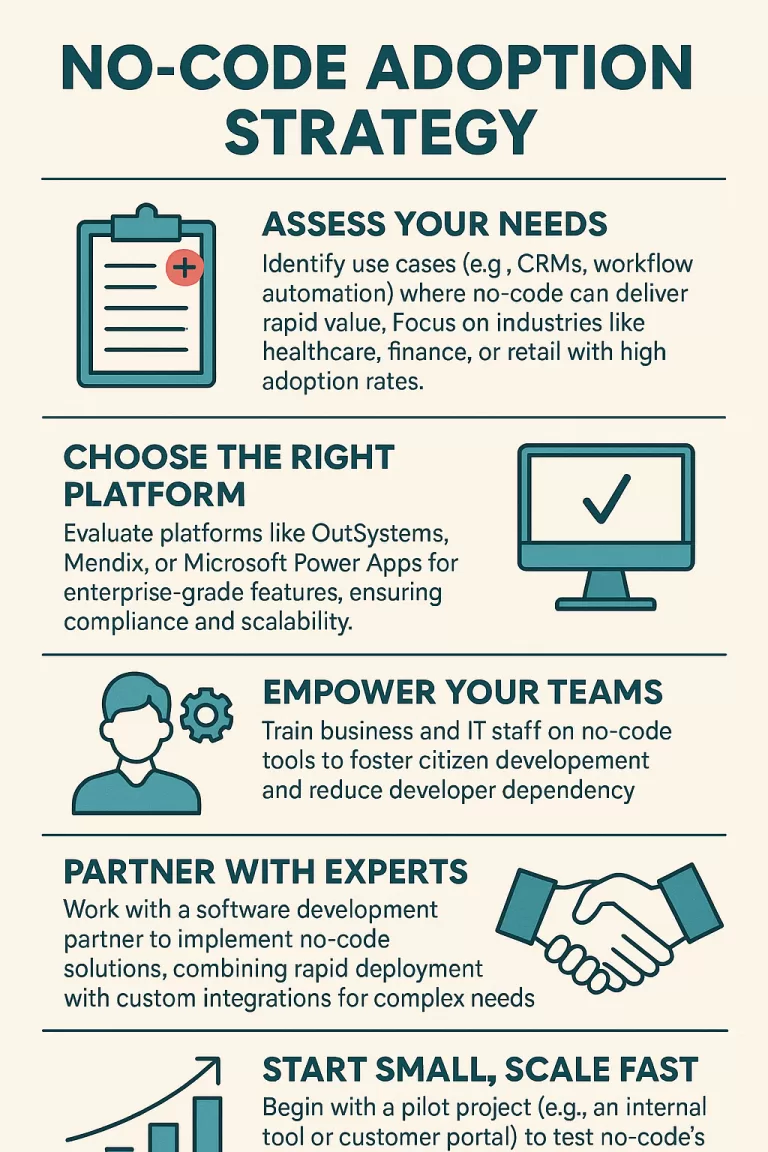
- Assess Your Needs: Identify use cases (e.g., CRMs, workflow automation) where no-code can deliver rapid value. Focus on industries like healthcare, finance, or retail with high adoption rates.
- Choose the Right Platform: Evaluate platforms like OutSystems, Mendix, or Microsoft Power Apps for enterprise-grade features, ensuring compliance and scalability.
- Empower Your Teams: Train business and IT staff on no-code tools to foster citizen development and reduce developer dependency.
- Partner with Experts: Work with a software development partner to implement no-code solutions, combining rapid deployment with custom integrations for complex needs.
- Start Small, Scale Fast: Begin with a pilot project (e.g., an internal tool or customer portal) to test no-code’s impact, then scale to mission-critical applications.
Ready to revolutionize your enterprise with no-code? Contact our expert team to explore tailored no-code solutions, conduct a feasibility assessment, or kickstart your digital transformation journey. Schedule a consultation today to position your business as a leader in 2025’s no-code revolution!