

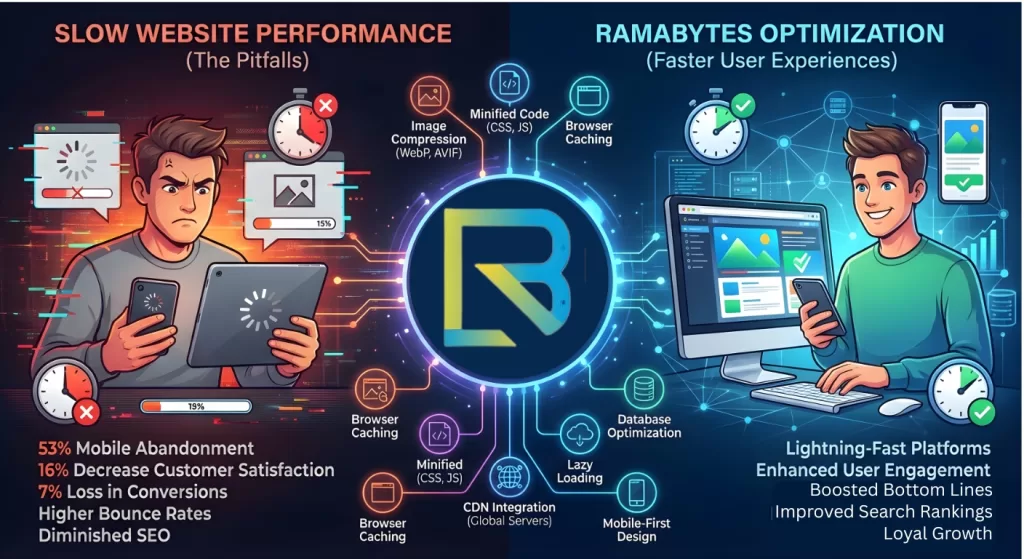
In today’s digital landscape, where attention spans are shorter than ever and competition is just a click away, the speed of your website can make or break your online presence. Imagine a potential customer landing on your site, eager to explore your offerings, only to be met with a spinning wheel or a blank page that takes forever to load. Frustration sets in, and within seconds, they’re gone—likely to a competitor’s faster site. This scenario is all too common, and the consequences are severe. Studies show that 53% of mobile users abandon sites that take longer than three seconds to load. Even a one-second delay in page load time can result in 11% fewer page views, a 16% decrease in customer satisfaction, and a 7% loss in conversions. For businesses, this translates to millions in lost revenue annually, higher bounce rates, and diminished search engine rankings.
As a global IT partner specializing in custom software solutions, web and mobile app development, digital marketing, and more, RamaBytes understands these challenges intimately. The organization focuses on delivering high-performance digital experiences that keep users engaged and drive business growth. By prioritizing website optimization, RamaBytes helps clients transform sluggish sites into lightning-fast platforms that enhance user satisfaction and boost bottom lines. This blog explores the pitfalls of slow loading times and delves into how RamaBytes employs proven strategies to optimize performance, ensuring faster, more seamless user experiences.
Understanding the Impact of Slow Loading Times
Slow website loading isn’t just an annoyance—it’s a business killer. In an era dominated by mobile browsing, where users expect instant gratification, delays can erode trust and professionalism. Research indicates that a one-second delay can decrease customer satisfaction by 16%, while sites making $100,000 daily could lose up to $2.5 million yearly from such lags. Beyond immediate user frustration, slow sites suffer in search engine optimization (SEO). Google and other search engines prioritize fast-loading pages in their rankings, using metrics like Core Web Vitals to assess user experience. Poor performance here leads to lower visibility, reduced organic traffic, and higher abandonment rates.
From a user perspective, the effects are multifaceted. High bounce rates occur when visitors leave without interacting, signaling to search engines that the content isn’t valuable. This creates a vicious cycle: lower rankings mean less traffic, which further hampers engagement. For e-commerce sites, slow loads directly impact conversions—users abandon carts, leading to lost sales and increased acquisition costs. Even for informational or service-based websites, sluggish performance can damage brand perception, making the business appear outdated or unreliable. In competitive markets, where alternatives abound, speed becomes a differentiator. RamaBytes recognizes this, integrating performance optimization into its core services to help clients maintain a competitive edge.
Moreover, the rise of mobile-first users amplifies these issues. With varying network conditions, especially in regions like India where connectivity can be inconsistent, mobile sites must load efficiently. A slow experience not only drives users away but also discourages repeat visits and positive reviews. By addressing these impacts head-on, RamaBytes ensures that its clients’ websites deliver value quickly, fostering loyalty and growth.
Common Causes of Slow Website Performance
Before optimization can begin, it’s crucial to identify why websites load slowly. Several factors contribute, often stemming from design, development, or infrastructure choices. Large, unoptimized images are a primary culprit; they account for a significant portion of page weight, bloating load times without adding value. Excessive HTTP requests—triggered by multiple files like scripts, stylesheets, and fonts—also slow things down, as each request involves network latency.
Inefficient code plays a role too. Bloated JavaScript and CSS files, unnecessary plugins, or render-blocking resources force browsers to process more than needed, delaying the critical rendering path. Server-side issues, such as inadequate hosting, lack of caching, or distant server locations, exacerbate delays, especially for global audiences. Redirects, third-party scripts, and uncompressed assets further compound the problem, turning what should be a swift experience into a sluggish one.
RamaBytes conducts thorough audits to pinpoint these issues, using tools like Google’s PageSpeed Insights and Lighthouse to measure performance metrics. This diagnostic approach allows the organization to tailor solutions, addressing root causes rather than symptoms.
RamaBytes’ Approach to Optimization
RamaBytes employs a comprehensive, data-driven strategy to optimize website performance, drawing on industry best practices while customizing solutions to client needs. The process starts with a performance audit, evaluating current load times, resource usage, and user experience metrics. From there, the organization implements targeted optimizations across frontend, backend, and infrastructure layers.
One key technique is image optimization. RamaBytes compresses images without sacrificing quality, using formats like WebP and AVIF for better efficiency. They also implement responsive images, serving appropriately sized files based on device, reducing unnecessary data transfer. Lazy loading is another staple—non-critical images load only when they enter the viewport, speeding up initial page renders.
To minimize HTTP requests, RamaBytes minifies and combines CSS and JavaScript files, removing whitespace and comments to shrink file sizes. They leverage browser caching, setting expiration headers so returning users load assets from local storage rather than the server. Enabling gzip or Brotli compression further reduces data sent over the network, often cutting sizes by 70% or more.
Infrastructure enhancements are vital. RamaBytes recommends and integrates Content Delivery Networks (CDNs), distributing content across global servers to reduce latency for users worldwide. Upgrading to HTTP/2 or HTTP/3 protocols allows multiplexing, enabling multiple requests over a single connection for faster transfers. On the backend, they optimize databases, implement server-side caching with tools like Redis, and ensure efficient code execution.
Critical rendering path optimization is a focus area. RamaBytes prioritizes above-the-fold content, inlining essential CSS and deferring non-essential scripts to prevent render-blocking. They minimize redirects and scrutinize third-party scripts, loading them asynchronously to avoid bottlenecks.
For mobile optimization, RamaBytes adopts a mobile-first design, ensuring responsive layouts and accelerated mobile pages (AMP) where applicable. Continuous monitoring with real-user monitoring (RUM) tools helps track performance post-launch, allowing iterative improvements.
Through these methods, RamaBytes has helped numerous clients achieve sub-three-second load times, enhancing user engagement and SEO rankings.
Real-World Benefits and Examples
The results of RamaBytes’ optimizations speak volumes. Clients report up to 40% reductions in bounce rates and significant conversion uplifts, aligning with industry benchmarks where faster sites see higher engagement. For instance, an e-commerce platform optimized by RamaBytes experienced a 25% increase in page views after implementing CDN and image compression, leading to boosted sales during peak seasons.
In another case, a content-heavy site plagued by slow loads saw its SEO rankings climb after minification and caching tweaks, drawing more organic traffic. These outcomes underscore how performance directly ties to business success, with faster experiences fostering user loyalty and revenue growth.
Conclusion
Slow website loading times are more than a technical glitch—they’re a barrier to user satisfaction and business prosperity. By understanding the impacts and causes, and applying rigorous optimization strategies, organizations can turn this challenge into an opportunity. RamaBytes excels in this arena, offering end-to-end solutions that prioritize speed without compromising functionality or aesthetics. Whether through image tweaks, code efficiencies, or infrastructure upgrades, the organization’s expertise ensures clients deliver exceptional digital experiences.
In a world where every second counts, partnering with RamaBytes means investing in performance that drives results. If your site feels sluggish, it’s time to optimize—your users, and your bottom line, will thank you.